In today's competitive market, choosing the right finish for doors can be confusing. Many people ask, "why is powder coating better than painting for doors?" Industry expert John Smith, a veteran in coatings, explains, "Powder coating provides durability and a flawless finish that traditional paint cannot match."
Powder coating is a process that involves applying dry powder to surfaces. This process creates a thicker layer than conventional paint, making it more resilient to scratches and weather conditions. Smith also notes that powder coated doors resist fading better than painted ones. The colors remain vibrant and fresh for years, even under harsh sunlight.
However, some may overlook the initial cost of powder coating. It might seem higher compared to painting, and the application process is also less common. This leads to a challenge: not all contractors are equipped to use powder coating effectively. As with any finish, it’s essential to weigh the long-term benefits against short-term costs.
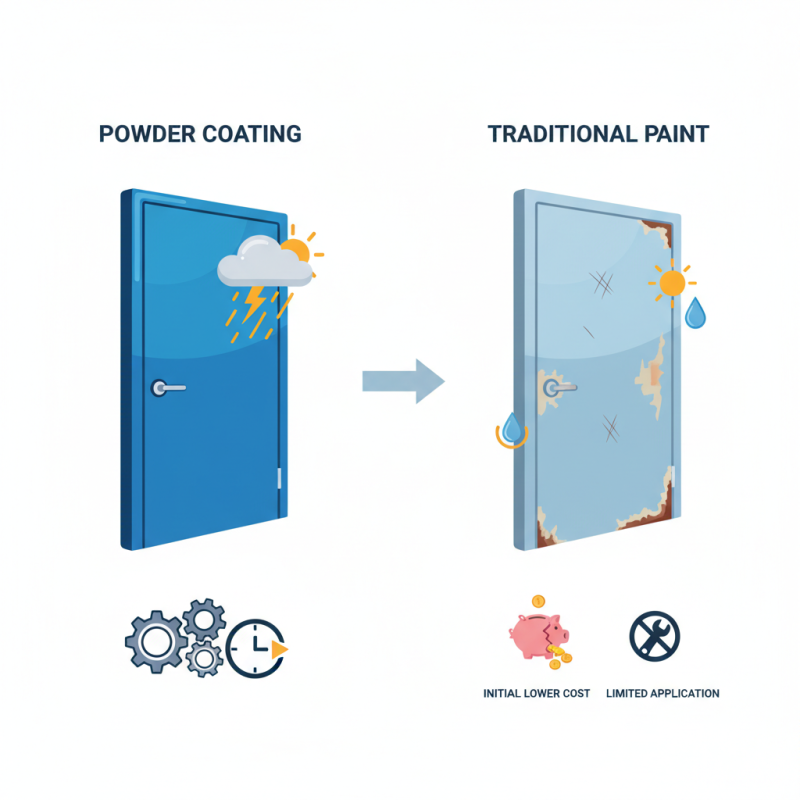
Powder coating has become a popular choice for doors, and for good reason. Its durability is one of the main advantages. Unlike traditional paint, which can chip or peel, powder coating forms a hard shell. This layer protects against scratches and weather elements. Imagine opening a door in a storm, only to find the finish intact.
Another advantage is the variety of finishes available. Powder coating offers a wide range of colors and textures. You can choose glossy, matte, or even textured finishes. This flexibility allows homeowners to find the perfect match for their style. However, the application process requires precision. If not done correctly, the finish may not adhere well. It’s crucial to ensure proper surface preparation.
In addition to aesthetic appeal, powder coating is more environmentally friendly. Traditional paints often contain solvents that contribute to air pollution. Powder coating contains no volatile organic compounds. Yet, it requires higher curing temperatures, consuming more energy. There’s a balance to strike between sustainability and efficiency. Exploring these nuances can lead to better choices for home improvement projects.
| Advantages | Powder Coating | Traditional Painting |
|---|---|---|
| Durability | Highly resistant to chipping, scratching, and fading | Susceptible to chipping and fading over time |
| Environmental Impact | Low VOC emissions, eco-friendly options available | Higher VOC emissions, can be harmful to the environment |
| Finish Quality | Uniform and smooth finish with no runs or drips | May exhibit runs, drips, or texture variations |
| Application Process | Applied as a dry powder and cured under heat | Applied as a liquid with a brush, roller, or sprayer |
| Maintenance | Requires minimal maintenance; easy to clean | May require regular touch-ups and maintenance |
| Color Retention | Colors stay vibrant longer; resistant to UV rays | Colors may fade or change over time due to UV exposure |
: Powder coating releases minimal volatile organic compounds (VOCs), contributing to better air quality.
Powder coating generates less waste and allows for higher transfer efficiency, minimizing unused product.
Yes, the initial cost is often higher, but durability may justify the expense over time.
Powder coating offers vibrant colors and various finishes that maintain their integrity over time.
Yes, color consistency can differ, so expertise in application is important to avoid mismatched finishes.
Some may find decision-making overwhelming due to the vast color options. Also, an imperfect finish can occur.
The right hue can elevate a door's look, creating a focal point. Poor choice may lead to aesthetic conflicts.
No, unlike paint, powder coating does not run or drip, ensuring a more uniform finish.
Powder coating typically requires lower maintenance than traditional paint, making it a practical choice.
Some find the glossy finish less appealing, prompting a reflection on design alignment with home themes.
Powder coating has emerged as a superior choice for finishing doors compared to traditional painting, primarily due to its numerous advantages. One of the key reasons why powder coating is better than painting for doors lies in its exceptional durability and longevity. Powder-coated surfaces resist chipping, scratching, and fading much more effectively than painted finishes, making them ideal for high-traffic areas.
Additionally, powder coating is more environmentally friendly than conventional paint, as it produces fewer volatile organic compounds (VOCs) and waste. The range of color and finish options available in powder coating allows for greater customization while maintaining a consistent appearance. The application process for powder coating is also efficient, involving electrostatic attraction followed by curing in an oven, resulting in a tough, even coating. Overall, the combination of durability, environmental benefits, and aesthetic flexibility makes powder coating the preferred choice for door finishes.

 Med Door