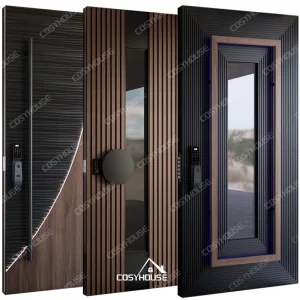
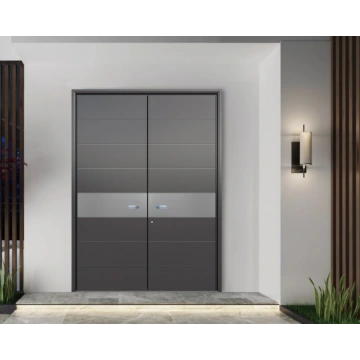
Explore the initial selection of our engineered security doors, blending cutting-edge security framework integrations with precise structural endurance.
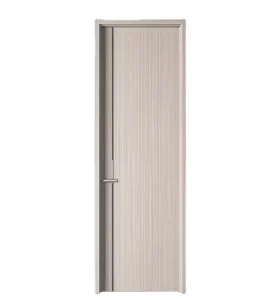
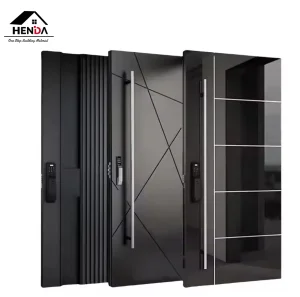
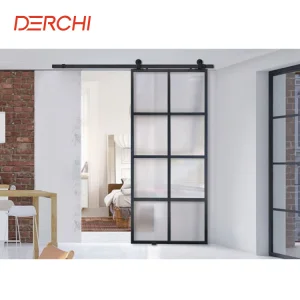
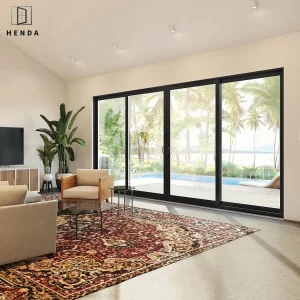
In an era characterized by complex geopolitical fluctuations, rapid urbanization, and hyper-automated supply chains, the physical security of commercial, municipal, and industrial facilities has emerged as a cornerstone of corporate risk mitigation. Industrial security doors are no longer simple mechanical entry barriers; they are highly engineered nodes within a facility's defense infrastructure. Modern industrial door assemblies are tasked with balancing multiple performance directives: structural resistance against unauthorized penetration, thermal efficiency to meet global decarbonization standards, acoustic isolation for heavy-machinery boundaries, and seamless integration with smart access control ecosystems.
As global procurement officers seek reliable, cost-effective, and fully certified partners, China has firmly established itself as the leading powerhouse in the fabrication of advanced security entrances. The combination of complete domestic vertical integration, continuous capital investment in state-of-the-art CNC and automated robotic lines, and adherence to international validation standards (such as EN, UL, CE, and ISO) positions Chinese factories as the strategic choice for global infrastructure, logistics, and residential projects.
True authority in industrial security engineering is measured in certified testing performance. Suzhou Med Door Technology Co., Ltd. brings 15 years of continuous manufacturing research, maintaining rigorous adherence to ISO9001:2015, ISO14001:2015, CCC (China Compulsory Certification), and European CE standards. By focusing on smart mechanical engineering and structural resilience, our systems deliver validated performance profiles under extreme environmental and mechanical stress.
Procuring industrial security doors from top-tier Chinese suppliers yields significant, measurable advantages that stretch far beyond simple unit-price economics.
Chinese manufacturers operate within highly concentrated industrial clusters, allowing immediate access to specialized metallurgical treatment facilities, heavy-duty hinges, precision gaskets, and custom hardware. This ecosystem drastically reduces lead times for bespoke configurations and keeps production agile.
Top-tier factories integrate advanced fiber-optic laser cutting machines, automated panel bending cells, and multi-axis CNC routers. This level of automation ensures micro-millimetric precision across complex production runs, ensuring perfect field installations.
Whether integrating high-integrity polymer cores for wet pharmaceutical chambers, specialized internal reinforcements for hurricane mitigation, or custom structural steel framing for extra-tall entrances, Chinese engineering accommodates tailored structural specs with ease.
As buildings become smarter and more environmentally conscious, the specifications of industrial security doors are shifting rapidly. Understanding these trends is crucial for specifiers, architects, and developers who seek long-term ROI on new facilities.
Modern envelope design requires absolute minimization of thermal bridges. Industrial sliding and entry doors now employ multi-chamber polyamide thermal break designs. By separating the internal and external profiles with structural, low-conductivity resins, these doors reduce U-values significantly, minimizing HVAC load in heavy commercial centers and cold chain hubs.
Traditional lock and key methods are giving way to high-security integrated biometric entry points. Industrial steel doors are pre-routed and wired with internal conduit pathways to house biometric scanners, smart magnetic card-access controllers, and remote monitoring sensors. This links physical entry doors directly to the centralized Building Management System (BMS) for real-time diagnostics.
Urban noise control regulations require intense acoustic insulation at the boundary of machinery rooms, loading docks, and municipal utility plants. Modern security door cores are filled with high-density mineral fiber matrices and polymer acoustic dampening layers, achieving STC (Sound Transmission Class) ratings up to 45dB.
Industrial security doors must perform reliably under highly specific stress scenarios. Here is how specialized designs serve key global industry verticals:
For procurement directors, project managers, and lead architects, purchasing industrial security doors from international manufacturers requires strict alignment with project performance benchmarks. An optimal procurement checklist should cover the following points:
Raw Material Verification: Insist on Mill Test Certificates (MTC) for steel and aluminum alloys. For moisture-prone environments, ensure structural aluminum frame profiles are powder-coated or anodized to resist surface rust and galvanic corrosion.
Validation and Certifications: Match certifications directly to regional codes. Ensure products meet standard performance metrics: UL 10C for positive pressure fire tests, EN 1627 for burglar resistance classes (RC1 to RC6), and ASTM standards for hurricane impact resistance.
Logistical Security and Packing: Custom industrial door assemblies are heavy and contain precision hardware. Ensure the manufacturer packages products using heavy-duty plywood crates, protective corner guards, and vacuum-sealed poly-wrapping to prevent structural deformation and moisture ingress during overseas transit.
Get professional technical insights regarding key compliance standards, core materials, and custom structural applications.
An industrial security door is classified by its capacity to resist structural penetration, physical attack, and environmental stress over specific durations. Certifications like EN 1627 rating classes (RC2, RC3, RC4) or UL safety listings verify that the door structure, lock configurations, frame anchor points, and hinges have undergone forced-entry tests using heavy impactors, manual tools, and power tools.
Thermal break profiles divide the aluminum door frame into separate exterior and interior sections, bonded together with a low-thermal-conductivity material (usually polyamide). This structural barrier prevents external cold or heat from migrating across the metal profile, preventing condensation and significantly improving U-value performance.
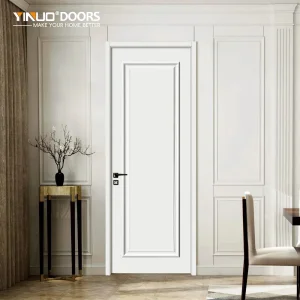
Traditional wood doors absorb ambient moisture, leading to warping, swelling, and structural delamination. High-performance cleanroom doors feature a solid polymer core and are laminated with moisture-proof PVC or HDF coverings. This construction eliminates air pocketing, maintains structural integrity under fluctuating humidity, and resists chemical sanitizers.
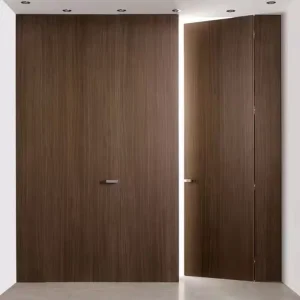
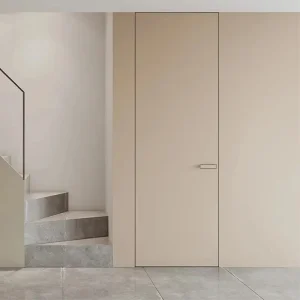
Invisible-frame wooden doors meet modern architectural preferences for seamless surfaces. The aluminum frame is embedded directly into the wall profile, covered by plaster or drywall. Combined with 3D-adjustable concealed hinges, the door panel sits flush with the wall surface, achieving a minimalist design while preserving sound insulation and fire resistance.
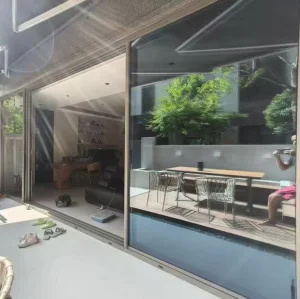
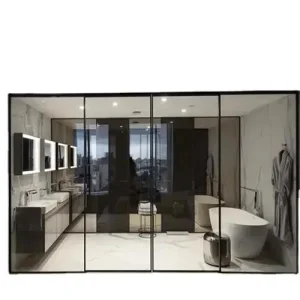
Yes. Premium exterior sliding doors integrate heavy thermal break aluminum structures with laminated impact glass (such as PVB or SentryGlas interlayer configurations). These systems are engineered to withstand positive and negative wind pressures, preventing breaches during windstorms and severe typhoons.
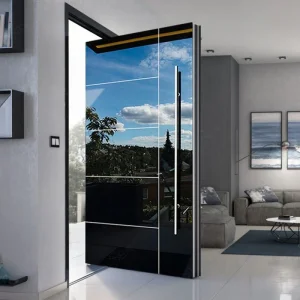
Browse our extended product line of specialty cleanroom doors, heavy-duty pivots, and weather-resistant security closures.
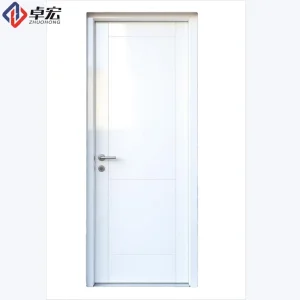
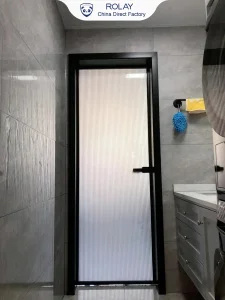
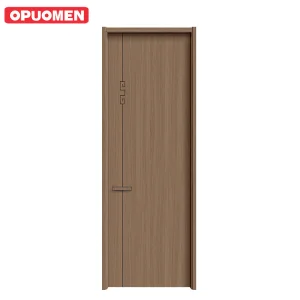
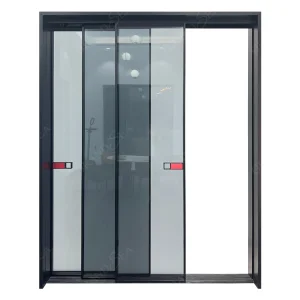
A 15-year legacy of manufacturing precision, international validation, and comprehensive structural solutions.
For the past 15 years, Suzhou Med Door Technology Co., Ltd. has been at the forefront of the building materials industry, bringing innovative, high-quality solutions to meet the evolving needs of customers. Our company has developed a reputation for excellence through the dedication of our skilled technical team and on-site installation professionals. We focus on providing comprehensive, scientific, and effective solutions throughout every phase of the project—from initial conception and design to production, construction, and installation.
Quality has always been the cornerstone of our success. Med Door Factory has integrated cutting-edge mechanical equipment, leveraging robust technical capabilities and precision manufacturing processes. This commitment to excellence has earned us the trust and respect of our clients, leading to us being affectionately known as "Aluminum Art and Home" in the industry.
As a result of our commitment to quality, Med Door has been recognized with numerous accolades, including the prestigious titles of "Exemplary Organization of Quality Management" and "Top Ten Famous Enterprises in the Industry." These honors highlight our continual effort to maintain high standards and industry leadership.
Looking ahead, Med Door remains committed to innovation and growth. Our mission is to foster progress alongside our partners and create greater value for society. We continually strive for excellence in every aspect of our work, adhering to stringent international standards, including ISO9001, ISO14000, and CCC and CE certification systems, ensuring that our products and services meet the highest quality benchmarks.
Our approach is deeply rooted in a strong R&D and production framework, underpinned by a comprehensive sales and service system that ensures our customers receive not only top-tier products but also exceptional support throughout the entire lifecycle of their projects.
At Med Door, we live by the principles of "Quality Innovation, Service First." We are committed to contributing to the advancement of intelligent, self-powered building materials, which not only enhance the functionality of buildings but also enrich the living and working environments of individuals worldwide. Let's move forward and achieve greater success—together.
 Med Door